

• Skip to primary navigation
  • Skip to main content
  • Skip to footer
  • Home
    • Contact us
    • Diabetes Advocacy Disclaimer
  • Blog
  • Downloads
  • Our Story
  • Diabetes Advocacy
  • Nav Social Menu

    Let’s Connect!

Diabetes Advocacy

Diabetes Advocacy

Living your best life with diabetes

  • Awareness and Mental Health
    • How to Have a Diabetes Meltdown Day
    • Tattoos
      • 7 critical things to know if you have diabetes and want to get a Tattoo
  • Financial information
    • Disability Tax Credit for people with diabetes
    • Financial Assistance in Canada
    • RDSP
    • Resources and Supports
  • Parenting
    • What a parent of a child with diabetes need to know
    • Back to School
  • Technologies
    • Diabetes Care Basics
      • Ketones
      • Sick Day tips
    • Continuous Glucose Monitoring Systems
    • Insulin Pumps
      • Pros and Cons
      • What are Basal IQ™ and Control IQ™ Technologies?
  • Travel tips
    • Flying with an insulin pump and CGM
    • 11 Tips for Cruising with Type 1 Diabetes
    • Getting Travel Insurance with Type 1 Diabetes
You are here: Home / Awareness and Mental Health / Type 1 diabetes and Suicide

Type 1 diabetes and Suicide

type 1 diabetes and suicide

September 10th is World Suicide Prevention Day ????. With the constant pressure of blood sugar levels, insulin, and expenses, it isn’t surprising that there seems to be a correlation between type 1 diabetes and suicide.

Compared with the general population, studies in Britain, the US, Canada, Finland, and Australia have all shown that young adults and people living with type 1 diabetes are up to 32.5% more likely to attempt suicide.

Again, diabetes is one of the most psychologically and behaviourally demanding chronic medical illnesses around. This is in part because 95% of diabetes care is managed by the person with diabetes.

There are no breaks or holidays. There is just the constant routine of trying to desperately balance insulin, activity levels, food, hormones, and glucose levels. It is not an easy task. In many cases, this leads to diabetes burnout or depression. In the worst case, it could lead a person with type 1 diabetes to suicide.

A researcher in a recent study done on young adults with diabetes in Quebec noted that “In addition to challenges inherent to adolescence, young adults with diabetes who transition to adult care need to adapt to a new adult-care provider and a treatment facility. They tend to perceive pediatricians as more family-centered and less formal compared to adult-care providers and this can sometimes make the transition difficult.” This can lead to increased bouts of depression and suicidal tendencies.

How professionals can help to reduce suicide in people with diabetes
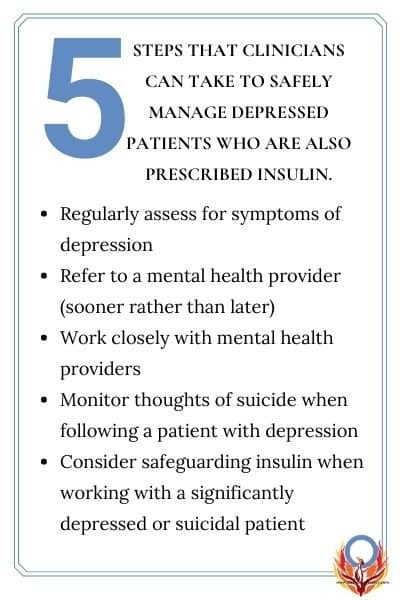
5 things clinicians can do to help depressed patients with diabetes

Thankfully, many organizations like the American Diabetes Association are now recommending routine screening for psychological issues like depression and watching for type 1 diabetes and suicide.

An article in the Primary Care Companion Journal of Clinical Psychiatry takes things one step further. It offers five steps that clinicians can take to safely managed depressed patients who are prescribed insulin. They suggest that patients are

  • Regularly assess for symptoms of depression
  • Refer to a mental health provider (sooner rather than later)
  • Work closely with mental health providers
  • Monitor thoughts of suicide when following a patient with depression
  • Consider safeguarding insulin when working with a significantly depressed or suicidal patient

Recognize some of the signs of suicide

If you or someone you know is experiencing any of the following…

  • Talking about wanting to die or to kill oneself
  • Looking for a way to kill oneself
  • Talking about feeling hopeless or having no reason to live
  • Talking about feeling trapped or in unbearable pain
  • Acting anxious or agitated; behaving recklessly
  • Talking about being a burden to others
  • Increasing the use of alcohol or drugs
  • Sleeping too little or too much
  • Withdrawing or feeling isolated
  • Showing rage or talking about seeking revenge
  • Displaying extreme mood swings

Please consider speaking with a health care professional immediately. The US Department of Health and Human Services considers the above list to be warning signs of suicide.
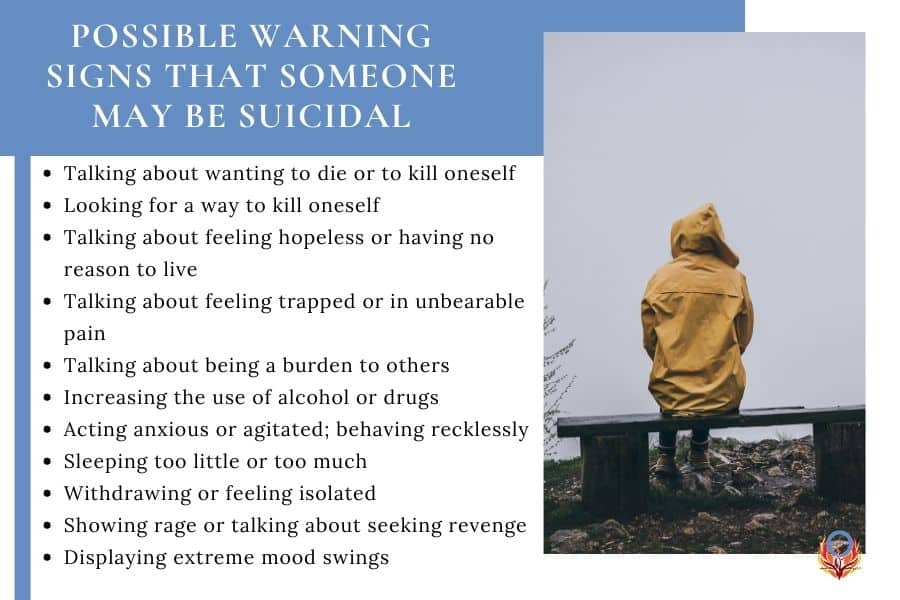
suicide warning signs

Who to call to help when having suicidal thoughts

There are many people that you can call if you have thoughts of suicide including a close friend or family member, your family doctor, or 911.

If you cannot reach a health care provider for any reason, please contact one of the mental health professionals we have listed on the Diabetes Advocacy resource page or call

  • Crisis Services Canada (1-833-456-4566 or text 45645)
  • Centre for Suicide Prevention (1-833-456-4566)
  • Kids Help Phone (1-800-668-6868)
  • The Suicide Prevention Lifeline in the United States at 1(800) 273-8255 of use their Twitter (@800273TALK) resources.

Remember that if you need immediate assistance, call 911 or go to the nearest hospital emergency room. Your life matters and help is available for you.

mental wellness

Managing your mental wellness

Tools to help your mental well-being

Learn more

Filed Under: Awareness and Mental Health Tagged With: depression, diabetes burnout, mental health, mental wellness [post_date}

Reader Interactions

Comments

  1. Rick Phillips says

    September 10, 2021 at 9:46 pm

    I am so moved by your post. I m doing a presentation at IDF this year about diabetes and depression, so your post is right up my alley. Thank you for highlighting what I believe is the least understood (or unappreciated) comorbidity of diabetes.

    rick

    Reply
    • Barb Wagstaff says

      September 17, 2021 at 11:56 am

      Thank you so much Rick. This subject really does break my heart.

      Reply

Leave a Reply to Rick Phillips Cancel reply

Your email address will not be published. Required fields are marked *

This site uses Akismet to reduce spam. Learn how your comment data is processed.

Get valuable information sent straight to your inbox!

Join Diabetes Advocacy's email list for great tips and information.

Please wait...

Thank you for joining us. We can't wait to get to know you!

Footer

Meet the creator

Hi there! I am Barb, the creator of the Diabetes Advocacy website. I began this site many years ago after my 2-year-old son was diagnosed with type 1 diabetes. Together we have grown and impacted lives around the globe! Read More…

Disclaimer…in case you didn’t already know…

I am not a medical professional but have played one in real life.

Please consult your medical team before making any changes to your diabetes care. This site does NOT replace medical advice.

You can read our complete disclaimer statement here.

Technology

  • CGM
  • Flash Monitors
  • Glucometers
  • Insulin pumps

Financial and Social Supports

  • Disability Tax Credit
  • Insulin pump programs
  • Social support
  • Other resources

About Us

  • Contact us
  • Our diabetes story
  • What others say
  • Our DTC story
Diabetes Advocacy

Copyright © 2026 · DiabetesAdvocacy · All material on this site is subject to copyright protection including text and pictures.

No portion may be reproduced without express written permission ·

This website uses cookies to improve your experience. We'll assume you're ok with this, but you can opt-out if you wish.Accept Read More
Privacy & Cookies Policy

Privacy Overview

This website uses cookies to improve your experience while you navigate through the website. Out of these, the cookies that are categorized as necessary are stored on your browser as they are essential for the working of basic functionalities of the website. We also use third-party cookies that help us analyze and understand how you use this website. These cookies will be stored in your browser only with your consent. You also have the option to opt-out of these cookies. But opting out of some of these cookies may affect your browsing experience.
Necessary
Always Enabled
Necessary cookies are absolutely essential for the website to function properly. This category only includes cookies that ensures basic functionalities and security features of the website. These cookies do not store any personal information.
Non-necessary
Any cookies that may not be particularly necessary for the website to function and is used specifically to collect user personal data via analytics, ads, other embedded contents are termed as non-necessary cookies. It is mandatory to procure user consent prior to running these cookies on your website.
SAVE & ACCEPT