

Words like “The Edmonton Protocol” and “islet cell transplants” are ones that people with type 1 diabetes have read with great enthusiasm over the years. When news of the Edmonton Protocol was first released, many wondered when they would be able to sign up to be cured. In the summer of 2007, I learned that this was a therapy and not a cure.
What is an islet cell transplant?
An islet cell transplant requires the isolation of islet cells from a donor pancreas. Approximately 500,000 cells are isolated from one donor. They are then transplanted into a waiting recipient. Each recipient requires at least 300,000 cells and will need a second transplant within a few months of the first to successfully reduce or remove the need for injected insulin.
One Step Up From a Lab Rat
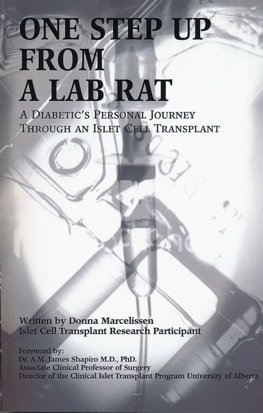
I was recently given the opportunity to learn a lot more about the Edmonton Protocol and the people who have received islet cell transplants. Donna Marcelissen asked me if I would be interested in reading her book “One Step Up From a Lab Rat”. It was a self-published book about going through the transplant process, what led her there and what happened after. I jumped at the chance to learn more and was amazed by what I read.
The experience of an islet cell transplant recipient
Donna had had type 1 diabetes for over 20 years before getting her first islet cell transplant. In her book, she explains that her successful business had to be scaled back over time because of severe neuropathies of the stomach, chest, hands, and legs.
She was using injected Gravol daily simply to be able to function. She also was going blind despite 23 eye surgeries and was hypoglycemic unaware. Donna stated that “most people believe that insulin and diet are all that a diabetic needs to follow in order to live a healthy, complication-free life….however, this is a disease and how the body reacts to it is not predictable.” My heart broke.
Donna was experiencing incredibly debilitating complications because of type 1 diabetes. She was however, still cautious about subjecting herself to the Edmonton Protocol. She was one of the very first thirty-five people to receive this treatment. Donna knew very little about the process. There was no one to ask if the challenges would be worth the results. As Donna filled out forms and subjected herself to further testing to see if she was an eligible candidate for the process she began to fear not being able to have the transplant.
“This transplant would alleviate the guilt of feeling there should be something more I could do. We could begin to make future plans.”
The financial burden of islet cell transplants
Donna Marcelissen lived in Ottawa and had to relocate to Edmonton for at least one year. They had to pay out of pocket for a second home and all of its expenses in Alberta while continuing to maintain their family residence in Ontario. Donna and her husband were also responsible to cover the $3000 airfare to fly at a minute’s notice to Edmonton to have the first procedure done. There were also drugs that would cost her over $35,000 per year that had to be covered.
Between her income and her husband’s, the Marcelissens were able to cover the expenses associated with Donna’s transplant but in her book she brings up two very valid points… “Should money be the deciding factor as to whether someone should live or die?” and what were the cumulative costs of all of the complications she was experiencing? Surely the cost of procedures, medications as well as a significant reduction in her taxable income were all far greater than the cost of covering islet transplant therapy.
Donna tells me that the procedure itself is no longer covered by provincial governments. “Capital Health covers their constituents. The government of Ontario refuses to cover it. It is only through applications and special access that the possibility transplantation exists for individuals. The costs of medications, staying in Edmonton while waiting for the procedure, and traveling (by air) are not covered, however.”
Donna Marcelissen’s story is amazing
As you read Donna’s story you struck by many things. First is her strength and courage. The pain and suffering that she experienced both before and after her transplants will bring you to tears.
As Donna writes, you are compelled to hang on every word. She describes her first breakfast reading after the procedure in exquisite detail.
Her pre-breakfast reading was an incredible 5.2mmol (94mgdl) and she treated herself to a glass of cranberry juice. This was a luxury she hadn’t afforded herself in 21 years because of the high fructose and glucose content. “It was sumptuous, with a fragrant, ripe sweetness that left a tangy aftertaste to linger on my tongue. Flowers in my mouth…”
By Donna’s second transplant, she enjoyed a longer period of time completely insulin freedom. In the book One Step Up From a Lab Rat, she also shared the incredibly emotional experience of having some of her vision restored as her blood glucose levels stabilize into a normal range. Her descriptions made you part of the experience and you could feel her joy.
Despite the highs and lows, Donna states that transplant recipients feel an obligation to their donors to do the very best with what they have been given…a gift of life. With this book and through her subsequent work with groups like Diabetes Canada, the Juvenile Diabetes Research Foundation and DRIFCAN, Donna has done amazing things with her gift of a new life.
Life after the Edmonton Protocol
Donna Marcelissen has had three islet cell transplants to date. The option for another “top-up” is still available to her but she told me that she isn’t certain that she is ready.
“I have had my immune system greatly suppressed (Leukopaenic ) for each of the three transplants – I’m not certain I want to undergo that again. But never say never. However, being able to say that I feel like I have an option is a good indicator that I am doing so much better. I have had a reprieve three times from this horrid disease. I do deal with some stressful complications from long term immune suppression medication use – but I try to put it into perspective. Issues arise, I seek medical help, learn to cope and work on moving forward.”
Final Thoughts on One Step Up From A Lab Rat
One Step Up From a Lab Rat is an incredible read. You will find yourself alternating between wanting to turn the page to see how she is doing and having to step away because of the sheer depth of emotions that you are feeling. Donna reminds us that “Insulin is not a cure. It does not even sustain some. Complications are not just from neglect but they can be the nature of the disease.”
To purchase your copy of One Step Up from a Lab Rat, click on the button below. All proceeds from the sale of this book go to the DRIFCan to continue the work of the Edmonton Protocol.


I know of a lady who had two of these in the US and both failed sort of. I hope the day will come someday when we can all afford a solution to T1D. We will eventually get there. When it gets to me (age 62) then we will knwo we have something. 🙂
Wow! Donna is truly an inspiration. What a strong and courageous woman.
I agree! Her story was so moving.