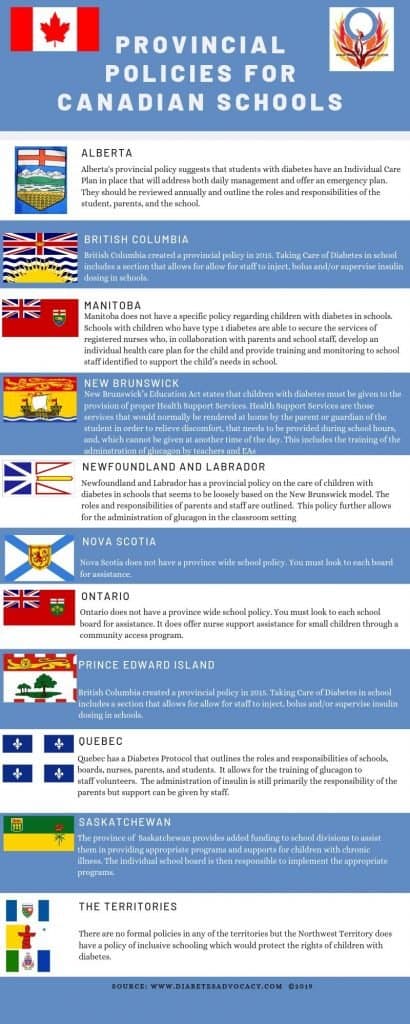

In Canada, there are no federal policies that govern the care of children with diabetes in schools. Education is under the jurisdiction of each province. It is therefore up to the province or individual school boards to put in place a school policies for children with diabetes in their school systems.
Currently most provinces and territories have implemented some sort of framework to protect the rights and health of children with diabetes in school. The level of assistance available can still vary from province to province.
ALBERTA’S POLICIES FOR CHILDREN WITH TYPE 1 DIABETES IN SCHOOL
Alberta operates under the authority of the Alberta School Act. In 2019, they implemented a provincial policy for children with diabetes in school.
It suggests that children with type 1 diabetes should have an Individual Care Plan. The plan will address both daily management and offer an emergency plan. They should be developed with collaboration between parents, the school, and health service partners. They should be reviewed, and changed if needed, on an annual basis.
The new guidelines for treatment of children with type 1 diabetes in Alberta further outline the roles and responsibilities of the student, parents, and the school. The guidelines state that “Working cooperatively with parents/guardians, school staff, healthcare professionals and community service providers is critical to a successful ICP and management of the child/student’s medical needs.”
You can read the entire document and its recommendations below.
British Columbia’s policy on children with type 1 diabetes in school

Diabetes in School: With appropriate planning, an individual with diabetes can participate in all school activities. Individuals with diabetes may, at times, require assistance and support from teachers and school staff. Individuals should be encouraged to manage their diabetes care in the school setting, to the extent that is appropriate for their maturity and experience with diabetes. The extent of an individual’s ability to participate in self-care tasks should be agreed upon by the parent/guardian, school personnel, health care team and student if appropriate. When all team members work together, concerns relating to diabetes management of the individual, family and school staff can be effectively addressed.
The March 2015 policy does allow for staff to inject, bolus and/or supervise insulin dosing in schools.
Manitoba
Manitoba currently does not have one provincial policy for children with diabetes in schools. According to Gerald Farthing, then Assistant Deputy of the Province of Manitoba, since 1995, Manitoba Education and Youth has been in partnership with our departments of Family Services and Housing and Health to provide interdepartmental policy and funding support to community programs within our province through the Unified Referral and Intake System (URIS).
Community programs include schools, licensed childcare facilities and situations involving respite.
The Unified Referral and Intake System Procedural Manual provides a classification of special health care procedures and provides a protocol for community programs such as schools to follow. Monitoring diabetes is one of the Group B Classifications within the URIS Manual.
Schools with children who have type 1 diabetes are able to secure the services of registered nurses who, in collaboration with parents and school staff, develop an individual health care plan for the child and provide training and monitoring to school staff identified to support the child’s needs in school. The health care plan outlines the child’s specific health care needs and procedures with respect to diabetes and the necessary interventions required throughout the school day. The school staff utilizes the health care plan to assist them in providing for both the child’s educational and health care needs. If educational adaptations are required as a result of the child’s diabetes, school staff makes the necessary instructional adaptations to accommodate the child’s health care needs.
Manitoba School boards
Division Scolaire Franco-Manitobaine
Administering Medication in School
Flin Flon School District
Fort La Bosse School Division
School District of Whiteshell
Medical Situations
In all matters relating to special health care of students in school, procedure will be determined on a case by case basis. The source of procedures which will be consulted in such matters as the primary
reference and guideline is The Unified Referral and Intake System Manual developed by the Province of Manitoba. Recommended procedures will be considered insofar as they can be implemented in local settings. (See Procedural Guidelines M.1R)
Winnipeg
At the beginning of each year a health care plan is developed for each child with medical needs. Each plan reflects the needs and wishes of those involved in an individual child’s life.
New Brunswick’s school policy for Children with diabetes
Policy 704
New Brunswick’s Education Act states that in order for children to participate in school programs, and attend school, careful attention must be given to the provision of proper Health Support Services. Health Support Services are those services that would normally be rendered at home by the parent or guardian of the student in order to relieve discomfort, that needs to be provided during school hours, and, which cannot be given at another time of the day. All school personnel are impacted under these obligations, and whether or not a nurse is on the premises, the responsibility remains.
Children with diabetes in this province are considered to require Essential Routine Services. Parents are required to meet with school personnel before the beginning of each school year. Together they will set or review the student’s care plan and complete the Health Support and Care Form. All involved should also participate in a training session on life-threatening conditions and include teaching and support staff.
The school district is to designate school personnel other than the teacher who will be participating in providing routine care procedures. There must be more than one staff member trained to provide an alternate person in case of absence or unavailability.
Designated personnel must participate in the meeting with the parent or guardian in order to get a clear understanding of the student’s needs.
Students are required to wear proper medical identification (such as Medic Alert). They are also to carry emergency supplies with them at all times.
Should parents or guardians, following notification, refuse to participate in developing an individual care plan with the school, the principal shall:
Send a letter to the parents or guardians reminding them that their refusal to cooperate appears to be placing the security of the student at risk, according to their obligation under the Family Services Act.
To view the policy in its entirety and Health Support and Care Form go to
http://www.gnb.ca/0000/pol/e/704A.pdf and http://www.gnb.ca/0000/pol/e/704AB.pdf
The Department of Education has no official position on the administering of glucagon. Individual school districts have been handling requests as they are encountered.
For more information read A Handbook for Type 1 Diabetes in Schools
Newfoundland and Labrador’s policy for children with diabetes
Newfoundland and Labrador has released guidelines for caring for children with diabetes in all schools within the province. Based on the New Brunswick model, the roles and responsibilities of parents and staff are outlined. It is also important to note that this policy also allows for the administration of glucagon in the classroom setting.
Nova Scotia’s policy on children with diabetes in school

Nova Scotia has published the Guidelines for Supporting Students with Type 1 Diabetes (and Other
Diabetes Requiring Insulin) in Schools. In it the provincial Department of Education recognizes and endorses the basic right of all students to full and equal participation in education.
To address the special health care needs of students with diabetes in school, the Nova Scotia government advises school boards to follow the program planning process outlined in Policy 2.2 of the Special Education Policy. Parents of children with type 1 diabetes, school staff, and healthcare professionals are encouraged to work together to develop an Individual Diabetes Care Plan. This plan should identify routine daily supports for the student during the school day, as well as an Individual Diabetes Emergency Plan.
You can read the complete guidelines for children with diabetes going to school in Nova Scotia in this government document.
Northwest Territories policy on the management of children with diabetes in school
The Northwest Territories has a Departmental Directive on Inclusive Schooling. It states “Inclusive Schooling is a philosophical and practical educational approach, which strives to respond to individual students needs, and is intended to ensure equal access for all students to educational programs offered in regular classroom settings” (February 1993). A student who has medical needs as a part of his/her educational program is supported through the school administration of the school he/she attends. The school receives additional funding for supporting students with special needs. These funds may be used to hire educational assistants to help meet the medical needs of students in their classrooms.
Schools also have access to medical support and teaching from the public health nurses in Yellowknife and the community health nurses in communities outside Yellowknife. Health professionals often provide the necessary medical service(s) required for students with severe medical conditions or provide the training to school personnel who then can provide the medical support needed.
Policy explained as per Dan Daniels, Assistant Deputy Minister Education and Culture NWT
Nunavut

There is currently no policy in place for children with diabetes in this territory,
Ontario’s Policy on supporting children with prevalent medical conditions
In the 2018 school year, the government of Ontario implemented the policy is known as PPM 161- Supporting Children and Students with Prevalent Medical Conditions (Anaphylaxis, Asthma, Diabetes, and/or Epilepsy) in Schools. This is a first step in protecting the well-being of children with diabetes in Ontario schools.
Prince Edward Island’s policy for children with diabetes
In 2018, the province of Prince Edward Island created a 20-page document outlining the roles and responsibilities of parents, educators and school administrators to ensure students with Type 1 diabetes are provided with a safe and positive learning environment.
You can read the complete Guidelines for Diabetes Management in School below.
Quebec’s policy for children with diabetes

June 2011, the Quebec provincial government announced the implementation of a new Diabetes Protocol for Children with Type 1 diabetes in Quebec. This new protocol outlines the roles and responsibilities of schools, boards, nurses, parents and students. It is quite comprehensive and allows for the training of glucagon to staff volunteers. The administration of insulin is still primarily the responsibility of the parents, but support can be given by staff.
You can download the document below.
Saskatchewan’s policy on children with type 1 diabetes in school
The Ministry of Education in Saskatchewan requires school divisions and the CÉF to develop, update and
implement operational administrative procedures related to dealing with students with type 1 diabetes in schools.
All administrative procedures related to this item must:
- outline the ways in which school divisions are to act in specific circumstances related to the management of students’ diabetes, including detailing which staff positions will be responsible for handling, administering, securely storing and disposing of insulin
- describe how school divisions will provide professional development by qualified professionals and/or parents/guardians who have been trained by qualified professionals for staff to handle specific circumstances related to the management of students’ potentially life-threatening medical conditions; and, maintain records and transition plans for students living with diabetes including accurate, up-to-date individual care plans that include how to respond to a medical incident or life-threatening emergency.
You can view the complete policy on the government website.
Yukon Territory
While we have not found any formal policy for the protection of the rights of children with diabetes in Yukon schools, the government of the Yukon has been very supportive of the needs of children with diabetes.
Overview